The Koji Rebellion: How Japan's Oldest Biotechnology Became Tomorrow's Protein
In May 2023, researchers at NIZO Food Research in the Netherlands signed a collaboration agreement with Yaegaki Biotechnology of Japan. The subject was not a novel organism or a patented genetic sequence. It was koji—the same microorganism that has fermented sake, miso, and soy sauce for over a thousand years.
The partnership's stated goal: create alternative meat products using koji mycelium.
This choice matters more than it appears.
When Silicon Valley thinks about the future of protein, it imagines cellular agriculture: animal cells multiplied in bioreactors, precision fermentation using genetically modified microorganisms, lab-grown tissue engineered to replicate meat's molecular structure. These approaches are capital-intensive, require sophisticated biotech infrastructure, and depend entirely on Western institutional knowledge and patent frameworks.
Japan looked at the same problem and chose differently.
Instead of importing the Western biotech playbook, Japan's emerging food-tech sector is systematizing a technology its own institutions have been perfecting for centuries. Not as nostalgia. Not as heritage marketing. But as a deliberate technological strategy that inverts the conventional status hierarchy: the "traditional" knowledge becomes the advanced solution.
The question that nobody asked: Does this represent genuine technological sovereignty—a different pathway to the future that Japan had been quietly building all along? Or is it romantic nostalgia dressed in the language of innovation, a way of making fermentation look cutting-edge because Western alternatives have captured the institutional imagination?
The answer requires looking at what koji actually is, why Japan chose it, what the research is producing, and who stands to benefit or lose if this strategy scales.
What Koji Is (and What People Forget About It)
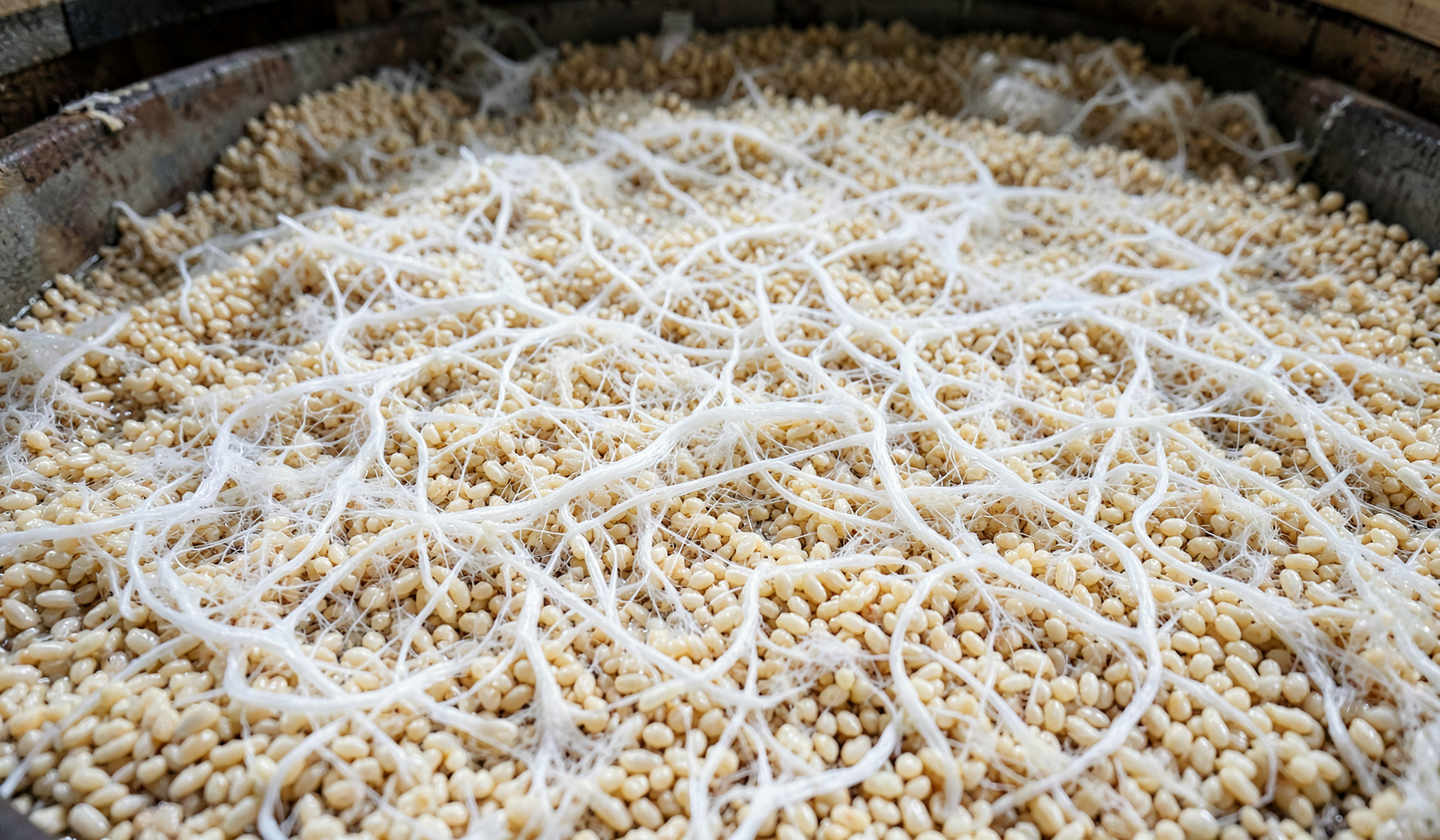
Koji—Aspergillus oryzae—is a fungus. It is not a plant. It is not a bacterial culture. It is a mold that grows in branching filaments called mycelium, fibers so microscopically similar to animal muscle fiber that they produce a texture indistinguishable from meat when properly cultivated and processed.
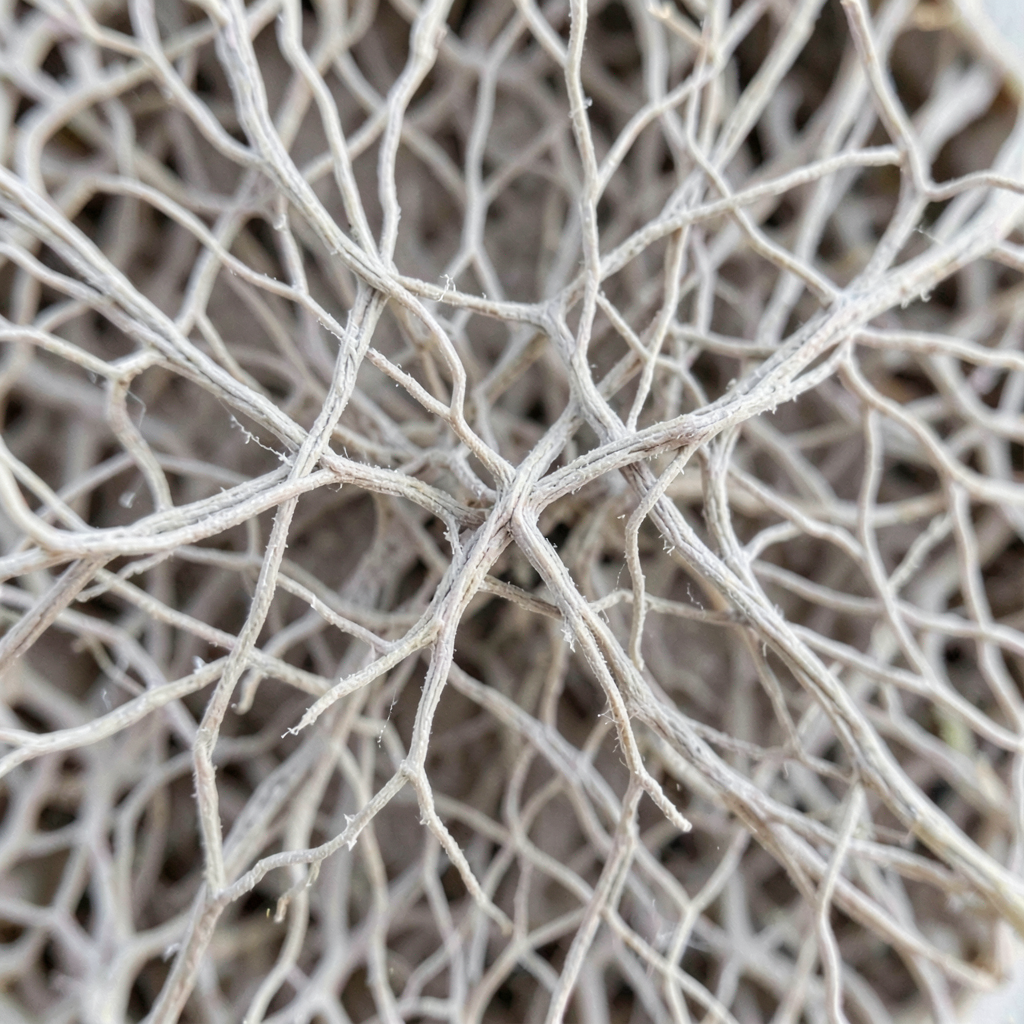
For roughly 2,000 years, koji has been doing the same job: breaking down starches and proteins in raw materials (rice, barley, soybeans, legumes) and converting them into edible, flavorful compounds. This is not magic. It is applied microbiology that predates germ theory by centuries.
A koji fermentation does not require electricity, climate control, or advanced facilities in the ways that cellular agriculture does. It does not require proprietary genetic engineering. It does not require the biotech infrastructure that the United States, Europe, and increasingly South Korea have spent decades building.
In 2006, the Brewing Society Japan formally declared koji the "National Fungi of Japan." This was not a ceremonial gesture. It was institutional recognition of an organism so central to Japanese food culture that its absence would unravel centuries of culinary tradition. Sake, miso, soy sauce, mirin, amazake, shio koji, shio koji—all depend on koji fermentation. Japanese cuisine, in structural terms, is built on koji's ability to transform raw materials into flavor and nutrition.
What matters about this history is that Japan had already solved the fermentation problem. Japan already knew how to cultivate koji precisely, predict its behavior, control its growth, harvest it, and process it into useful ingredients. The infrastructure was embedded not in laboratories but in breweries, in the hands of practitioners with generational knowledge, in institutional processes that have been iteratively refined over centuries.
When Western food-tech looked at alternative protein, it asked: How can we build something new?
When Japan looked at the same problem, it asked: What do we already know how to do at scale?
The Contemporary Signal: Sake Lees Become Beef
In July 2025, researchers published peer-reviewed findings in Nature npj Science of Food describing a novel protein-production process based on koji fermentation. The method was simple in principle: supplement koji fermentation with additional nitrogen sources, cultivate the mold on grain substrates (rice and maize), and measure the protein content of the resulting biomass.
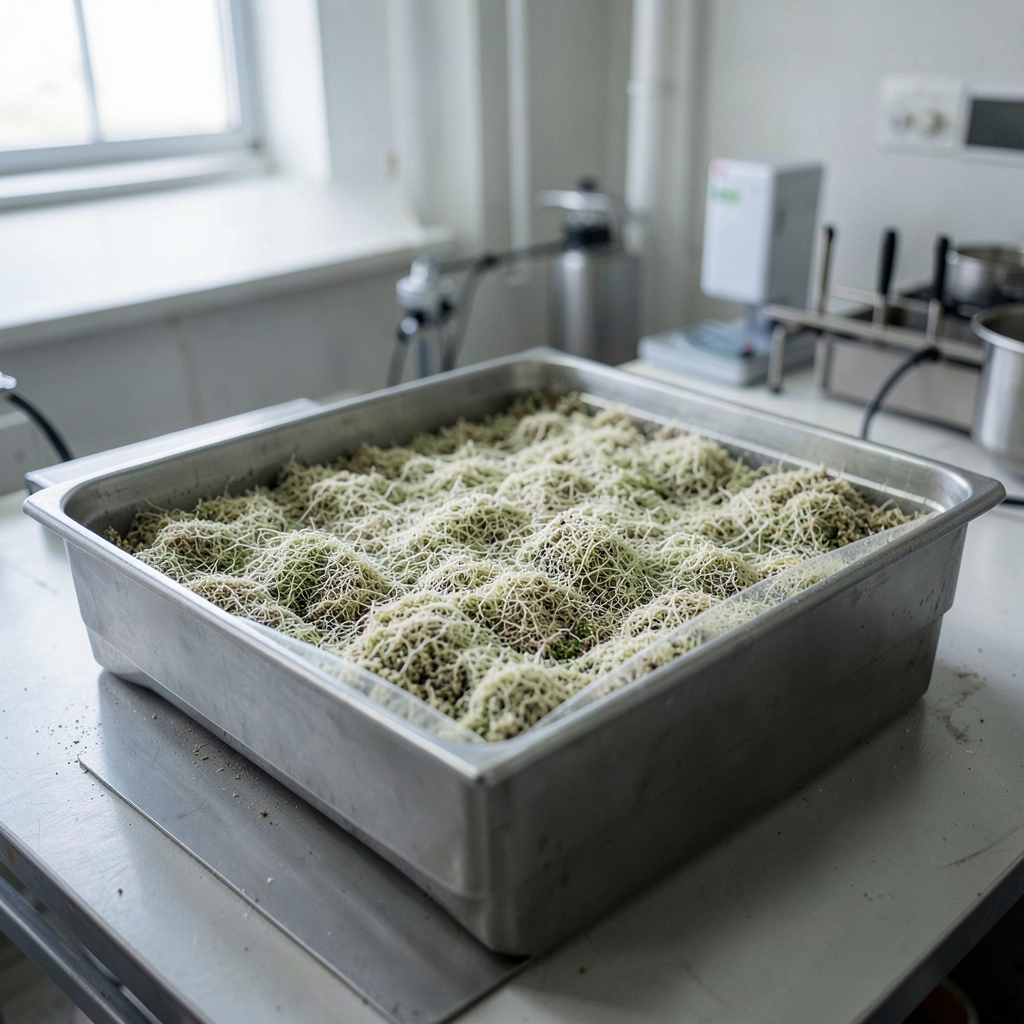
The results were quantified and specific: koji fermentation on rice reached 12.3% protein content; on maize, 13.2%. From one kilogram of maize grains, the process produced 124 grams of protein.
This is not theoretical. This is measured output.
The substrate used in the research included sake lees—kasutori, the white paste byproduct of sake brewing. Every sake brewery in Japan produces sake lees as a consequence of production. The material is not waste in the sense of being discarded; Japanese breweries have developed various uses for it (animal feed, composting, traditional pickles, distribution to neighbors). But it is surplus. It is material produced in volume that has no single dominant economic use.
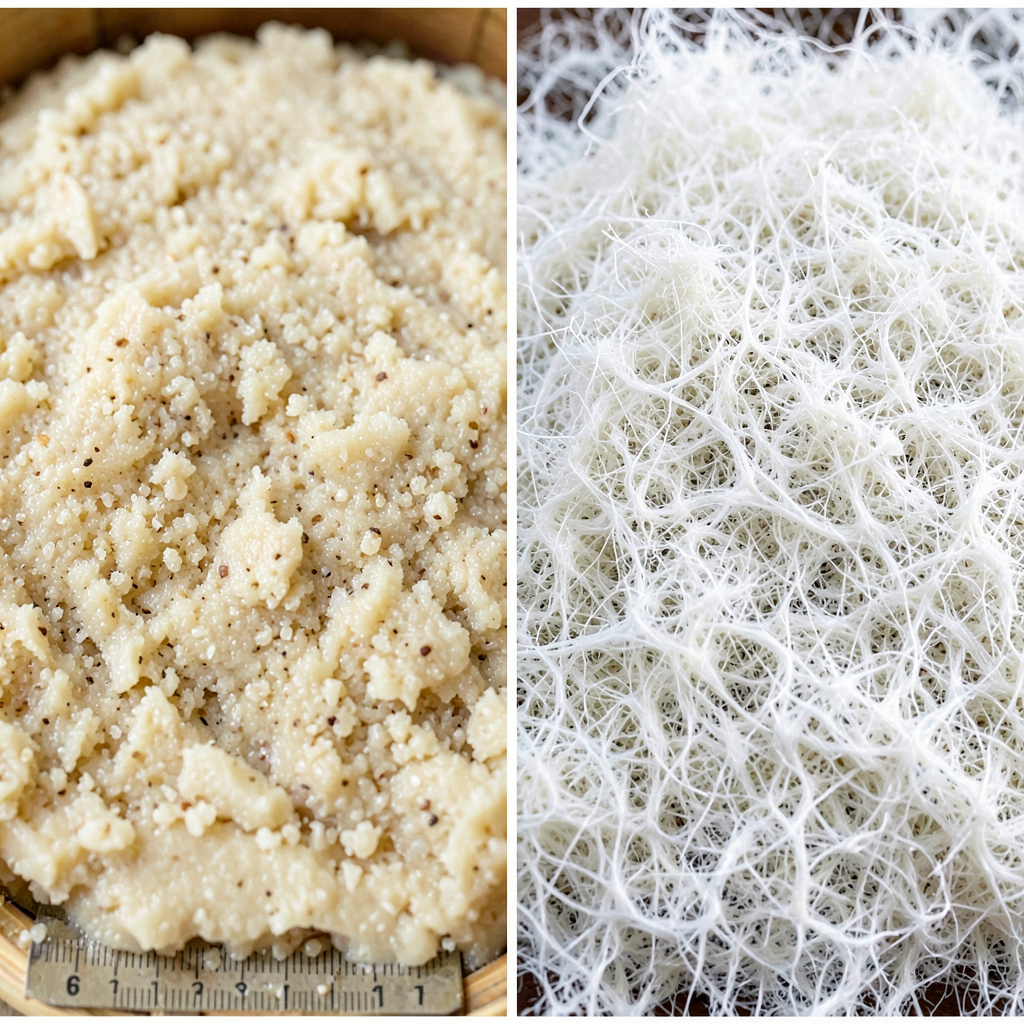
A brewing industry generates 200,000 tons of sake lees annually in Japan. If even a fraction of this could be converted into high-protein substrate for meat alternatives, the economic and environmental calculus changes. You have repurposed waste. You have created a new supply chain for fermentation substrate. You have connected two separate industries through a single organism.
The efficiency claims are documented: koji-based fermentation requires no advanced facilities and completes cultivation cycles within days. Compared to conventional beef production, the resource intensity is dramatically lower. Prime Roots, the California-based koji meat company, publishes claims of 92% less water and 91% lower land impact versus animal protein production.
These numbers are not yet peer-reviewed against all alternative-protein methods. But they are specific. They are measured. They are not aspirational.
Why This Matters: The Meiji Precedent
To understand why Japan is choosing fermentation as a biotech strategy, it helps to look at how Japan has historically treated fermentation knowledge.
During the Meiji era (1868-1912), Japan faced a specific problem: it had centuries of knowledge about fermentation embedded in artisanal brewing practices, but it lacked the industrial infrastructure to convert that knowledge into exportable commodities at scale.
Japan's response was to systematize artisanal fermentation knowledge into industrial process.
In Noda and Choshi, soy sauce production was mechanized and standardized. Sake brewing was formalized. Miso production was converted from household craft into regional industrial operations. By the Meiji era's end, fermented foods (sake, soy sauce, miso) were among Japan's top seven economic exports by monetary value. Japan had taken knowledge that existed in practitioners' hands and in cultural practice and converted it into infrastructure, standards, quality control, and international markets.
This was not nostalgia. It was strategic capitalization on embedded knowledge.
The contemporary koji research follows a similar arc. Japan is not borrowing Western biotech frameworks. It is asking: What if we took the fermentation knowledge we already possess—knowledge embedded in our brewing industry, our food practitioners, our centuries of refinement—and applied it to a contemporary problem that the world currently assumes requires Western biotech solutions?
The implicit statement is: We do not need to import the future of protein. We already fermented it.
The Verification Problem: What Actually Exists
This is where the investigation must become rigorous, because the narrative—Japan choosing fermentation, rejecting Western biotech, leveraging embedded knowledge—is powerful enough to survive without evidence.
What can be verified:
- Yaegaki Biotechnology (more than 50 years of koji research history; spin-off from a 350-year-old sake brewery) partnered with NIZO Food Research on koji-based alternative meat development (partnership signed May 9, 2023).
- Prime Roots, a California-based company, commercially produces koji-based deli meats, bacon, and charcuterie using koji mycelium. The product exists. It can be purchased. It demonstrates that koji-based meat textures are technically reproducible and commercially viable at small scale.
- Koji Lab and other emerging companies are developing koji-based proteins for human consumption.
- The Nature publication (July 2025) provides quantified data on koji protein production efficiency on grain and legume substrates.
- Sake lees are produced in industrial volume (200,000 tons annually) and are currently underutilized as a primary economic input.
What cannot yet be verified from available sources:
- The specific status of koji-based beef-texture research at Tokyo Metropolitan Industrial Technology Research Institute (TIRI). The proposal states this as active research. Available sources describe Japan's broader food-tech exploration using koji but do not confirm a specific TIRI beef-texture project with defined timelines or outputs. This is the single most important claim and requires direct institutional verification.
- Production timelines and scalability pathways from laboratory to commercial scale. The Nature research is recent (July 2025). Whether it represents a pathway to scaled production or remains confined to academic demonstration is not yet established in public documentation.
- The actual labor impact on fermentation practitioners and sake breweries. The proposal posits that koji-based protein could "restructure labor value" for "food workers, farmers, and fermentation practitioners in Japan currently occupying marginal economic positions." This is speculative. Evidence would require documentation of actual employment patterns, wage structures, and economic positioning before and after potential scaling of koji-based protein production.
- Head-to-head efficiency and cost comparisons between koji-based protein and Western alternative-protein methods (cellular agriculture, precision fermentation). Prime Roots publishes environmental claims. Specific cost or efficiency comparisons with cellular agriculture or precision fermentation are not established in available sources.
The Strategic Question Japan Is Asking (And Not Asking)
The koji research can be read as evidence of a deliberate strategic choice: Japan positioning itself in global biotech competition not by building cellular-agriculture infrastructure to compete with American and European laboratories, but by weaponizing fermentation knowledge that already exists within Japanese institutional and commercial culture.
But this interpretation requires accepting that:
- Japanese decision-makers deliberately chose fermentation over cellular agriculture as a protein strategy.
- This choice was made because Japan recognized fermentation as a competitive advantage rather than a limitation.
- The choice reflects genuine technological strategy rather than simultaneous pursuit of multiple protein approaches.
Evidence for this interpretation is partially available but incomplete.
Evidence against it:
- University of Tokyo researchers (including Shoji Takeuchi, a prominent tissue-engineering researcher) are simultaneously pursuing cultured meat and cellular agriculture. This suggests Japan is not exclusively committing to fermentation but rather developing multiple protein pathways.
- The koji research may be occurring because it is scientifically interesting and commercially viable, not necessarily because Japan has strategically rejected Western biotech approaches. Occam's Razor: multiple research institutions pursue multiple promising technologies.
- Framing sake lees "waste repurposing" as central to the innovation may overstate the problem being solved. Sake breweries already use sake lees for various purposes. Converting them to koji substrate is an additional use, not a solution to abandoned waste.
The stronger claim—that Japan is strategically positioning itself through fermentation rather than competing on cellular-agriculture terms—remains possible but not yet conclusively demonstrated in available documentation.
What the Research Team Actually Understands as Innovation
This is the investigative frontier.
When researchers at Yaegaki, NIZO, or Japanese food-tech institutions talk about koji-based protein as innovation, what specifically do they identify as the novel element?
- Is it koji itself (not novel; humans have used it for centuries)?
- Is it the cultivation process (potentially novel if they have developed new substrate preparations or control mechanisms)?
- Is it the texture output (possibly novel if koji mycelium can be processed to match beef characteristics better than previous attempts)?
- Is it the waste-repurposing mechanism (novel application if sake lees are being systematically converted to koji substrate at scale)?
- Is it the cost structure or resource intensity (novel economics if koji-based protein proves cheaper to produce than cellular agriculture)?
Available documentation does not provide clear answers to these questions from the researchers' own perspective. The Nature paper documents protein production efficiency. Prime Roots emphasizes texture and resource reduction. The NIZO-Yaegaki partnership is described as developing "alternative meat products" but without specification of what makes the approach distinct from simply growing koji on grain.
This gap—between the narrative (Japan leveraging ancient fermentation knowledge) and the actual technical innovation (specifically what is new about koji-based protein development)—is the investigative space OUTSIDE must occupy.
The Regulatory and Commercial Reality
If koji-based protein represents genuine technological sovereignty, it must be able to scale and reach markets without depending on Western biotech infrastructure, approval frameworks, or investment capital structures.
What is known:
- Koji protein is generally recognized as safe (GRAS) in the United States.
- The European Food Safety Authority classified koji-based fermentation as non-novel (meaning it does not require new approval pathways because fermentation using koji has been used for centuries).
- In Japan, koji-based foods have been consumed for over 1,000 years, so regulatory approval frameworks may be more streamlined than for novel Western alternative proteins.
What requires verification:
- What are the specific regulatory classifications for koji-based alternative proteins in Japan? Do they benefit from existing approvals for traditional fermented foods, or do they require novel-product approval frameworks?
- Can koji-based protein scaling avoid dependency on Western investment capital, or will commercial scaling require financing from Western biotech venture funds (thus recreating the dependency structure OUTSIDE investigates)?
- What are the actual production costs for koji-based protein compared to cellular agriculture? If koji-based production is genuinely cheaper, why hasn't it already scaled?
- Are there regulatory or institutional barriers unique to koji-based approaches that do not constrain Western cellular agriculture?
The answers determine whether koji represents genuine technological sovereignty or a promising alternative that ultimately remains subject to the same capital and regulatory constraints as Western approaches.
The Labor Question: Does This Actually Change Anything for Practitioners?
The proposal's human-stakes argument is that koji-based protein scaling could "restructure labor value" for food workers and fermentation practitioners "currently occupying marginal economic positions."
This requires specific evidence:
- How are sake breweries, miso producers, and koji practitioners currently positioned economically in Japan? What are documented wage structures, employment security, and income levels?
- If koji-based protein production scales to industrial volume, would it increase demand for koji cultivation expertise? Would sake breweries be positioned to supply koji substrate or would new commercial entities emerge to capture the economic value?
- Would koji-based protein production create new employment pathways, or would it consolidate koji cultivation into larger industrial entities, further marginalizing smaller practitioners?
- Are there documented cases of fermentation practitioners experiencing economic uplift when their traditional knowledge was industrialized (the Meiji precedent)? Or did industrialization extract the knowledge, consolidate production, and leave practitioners economically displaced?
The historical parallel to Meiji-era fermentation industrialization is instructive. Japan did systematize artisanal fermentation knowledge and create massive export industries. But this systematization also moved production from distributed artisanal practitioners into centralized industrial facilities. It is not clear that the transition benefited the original practitioners economically. It may have extracted their knowledge while consolidating the economic value into corporate structures.
If koji-based protein follows this historical pattern, the human-stakes narrative becomes more complicated. Food workers might gain employment at koji-cultivation facilities, but they would be working in industrial fermentation, not practicing traditional brewing craft. The "reactivation of indigenous knowledge" might mean the extraction and industrialization of that knowledge, with practitioners becoming line workers in scaled production.
This is the story that gets obscured when the angle focuses on "traditional knowledge becoming advanced technology." The technology might advance. The practitioners might be displaced.
Prime Roots: The Existing Proof of Concept
The strongest existing evidence that koji-based protein can reach market comes not from Japan but from California.
Prime Roots was founded in 2017 by Joshua Nixon and Kimberlie Le. The company grows koji mycelium on grain substrates, harvests the resulting biomass, and processes it into food products: deli meats, bacon, charcuterie, fresh slicing products sold through retail channels.
Prime Roots is not aspirational. It is operating. It is scaling. Its products exist in stores.
The company's documentation demonstrates that:
- Koji mycelium naturally produces fibrous structures resembling muscle tissue.
- This structure allows the koji product to be sliced at varying thicknesses, achieving textures and mouthfeels similar to cured meats.
- The resource intensity (water, land) is dramatically lower than animal protein production.
- The production process requires standard fermentation equipment, not advanced biotech infrastructure.
Prime Roots validates the core technical claim: koji can produce beef-like textures and can do so at resource efficiency levels that cellular agriculture struggles to match.
But Prime Roots is an American company. It is not evidence that Japan's koji-based protein strategy is distinct from or superior to Western approaches. It is evidence that koji-based protein can work as a technology, regardless of which nation develops it.
The question that remains unresolved: Is Japan developing koji-based protein differently than Prime Roots, or is Japan pursuing the same technology through its own research institutions?
The Contradiction at the Center
The strongest version of OUTSIDE's angle is this:
Japan is not merely developing koji-based protein. Japan is deliberately positioning fermentation—a technology it has perfected over centuries, that exists within its food culture and industrial infrastructure, that does not require Western biotech dependency—as the answer to a global protein problem that the West assumes requires Western biotech solutions.
This would be a statement about technological sovereignty. About the refusal to import problem-solving frameworks. About weaponizing embedded knowledge.
But the available evidence does not yet confirm this interpretation.
What is documented is that:
- Japanese research institutions are working on koji-based protein.
- This work is occurring alongside (not instead of) Japanese research into cellular agriculture.
- Koji-based protein is technically viable and commercially promising.
- Japan has unique advantages in koji expertise.
What is not documented is that Japanese decision-makers have strategically chosen fermentation as the pathway forward, or that they have rejected cellular agriculture as a competing approach.
It is possible that Japan is simply pursuing multiple protein strategies and koji-based research is one promising line among several. If so, the angle collapses from "Japan's deliberate strategic inversion of Western biotech" to "Japanese research institutions, like research institutions everywhere, are exploring multiple promising technologies."
The second interpretation is less dramatic. It is probably more accurate given available evidence.
But it is not necessarily the full story. The investigation must distinguish between:
- What is actually happening (koji-based protein research is active and promising)
- What decision-makers intend (unclear; simultaneous pursuit of multiple protein strategies suggests no single strategic choice)
- What emerges from the research over time (unknowable without future evidence)
OUTSIDE's job is to report what is actually happening and interrogate the assumptions embedded in the conventional narrative, not to confirm a predetermined angle by selecting evidence that fits and omitting evidence that complicates it.
The Sake Lees Detail: Waste or Substrate?
One recurring detail requires scrutiny: the idea that koji-based protein production "repurposes food waste" by using sake lees.
This is true technically. Sake lees are a byproduct of sake production.
But it may overstate the problem being solved.
Sake breweries produce 200,000 tons of sake lees annually in Japan. This is a large volume. But sake lees are not abandoned in landfills awaiting rescue. They are already being used for:
- Animal feed
- Composting
- Traditional pickling (sakura ninjin, etc.)
- Kasutori shochu (a spirit made from sake lees, produced by numerous breweries as value-added production)
- Distribution to local communities and home cooks
- Cosmetic products
- Agricultural soil amendment
Converting sake lees to koji substrate for alternative protein is an additional use, not a solution to an acute waste problem.
The narrative appeal is strong: "waste becomes beef." The reality is more subtle: "an already-somewhat-utilized byproduct finds another market use."
This does not invalidate koji-based protein. It simply means the environmental and economic benefits from sake-lees repurposing are likely smaller than the "turning waste into protein" framing suggests.
The Institutional Question: Is TIRI Actually Researching Koji Beef?
The proposal's foundational claim is that "The Tokyo Metropolitan Industrial Technology Research Institute is actively cultivating koji mold to create beef-like textures, reducing emissions and water use while repurposing food waste like sake lees."
Available sources do not directly confirm this specific claim from TIRI.
What is documented:
- Eat-Japan (February 2, 2026) describes Japan's food-tech sector developing koji-based "fungal meat" with beef-like textures, reduced emissions and water use, and sake-lees repurposing.
- The same source mentions that "TIRI" has developed cultured eel fat cells (cellular agriculture, not koji research).
- TIRI's predecessor institution (Tokyo Metropolitan Food Technology Center) conducted joint koji research with Marukome on pork garum (fermented seasoning), not beef-texture protein.
This gap is significant. The entire editorial commitment to the story depends on TIRI having an active koji beef-texture research project. If TIRI is not actually pursuing this research, the story's institutional framing collapses.
The investigation must verify directly with TIRI whether:
- They are conducting koji-based protein research.
- If so, is it focused on beef-like textures specifically?
- What are the research timelines and output goals?
- Are they open to documentation or interviews?
Without this verification, OUTSIDE cannot publish claims about TIRI's research as established fact. We can report what Yaegaki, NIZO, Prime Roots, and published research demonstrate. We cannot report TIRI's specific project without confirmation.
The Shareable Contradiction
If OUTSIDE publishes this investigation, the strongest viral object is not "sake lees become beef" (compelling but somewhat understates the complexity).
It is this:
"Japan is building the future of protein from something it figured out 2,000 years ago."
This works because it:
- Captures the core angle (temporal inversion: ancient knowledge becomes future technology)
- Is specific (protein, not generic "food" or "innovation")
- Contains surprise (the future looks like the past)
- Raises a genuine question (is this genuine strategy or nostalgia?)
- Can be paired with striking visual material (koji growth, fermentation vessels, historical brewing alongside contemporary research)
But this viral object only works if the investigation actually demonstrates that Japan has made a deliberate strategic choice to build protein innovation from fermentation rather than cellular agriculture.
If the evidence merely shows that Japan is pursuing koji research alongside other protein approaches, the framing becomes overstated.
What This Investigation Requires
Before OUTSIDE publishes "The Koji Rebellion," the reporting must establish:
- Direct verification from TIRI: Are they conducting koji beef-texture research? If yes, what are the specifics?
- Institutional intent interviews: Do Japanese food-tech decision-makers see fermentation as a strategic choice, or as one promising research line among several?
- Comparative production data: How do koji-based protein's resource intensity, cost, and production timeline compare to cellular agriculture when measured using identical metrics?
- Labor documentation: What is the current economic position of sake breweries and koji practitioners? If koji-based protein scales, how would it change employment and income structures?
- Regulatory pathway clarity: What are Japan-specific approval timelines and frameworks for koji-based alternative proteins?
- Commercial viability timeline: Based on current research velocity, when would koji-based protein be commercially available at scale? What are the documented pathways from laboratory to market?
- Visual documentation: Can OUTSIDE arrange to photograph koji cultivation, substrate preparation, and texture development at an accessible research or production site? Or document the actual process of sake lees being converted to koji substrate?
Without these elements, the story remains suggestive rather than conclusive. The angle is interesting. The evidence is partial.
The Final Rhetorical Question
Does koji-based protein represent genuine technological sovereignty, or is it romantic nostalgia dressed as innovation?
The question itself contains an assumption: that Japan has made a deliberate choice between fermentation and cellular agriculture, and that choice reveals something about how Japan positions itself in global biotech competition.
But what if Japan is simply doing what research institutions do everywhere: exploring multiple promising technologies simultaneously, some building on local advantages (koji expertise, fermentation infrastructure) and others building on global best practices (cellular agriculture, precision fermentation)?
What if there is no grand strategic inversion, only pragmatic diversification?
That interpretation is less dramatic. It is also probably closer to what is actually happening.
The investigation's job is not to confirm the dramatic interpretation. It is to report what is actually occurring, interrogate the assumptions embedded in competing narratives, and let readers draw their own conclusions.
If koji-based protein proves to be a genuine alternative to cellular agriculture—viable, scalable, cost-competitive—that is significant regardless of whether it represents strategic national choice or pragmatic institutional research.
If it remains confined to laboratory demonstrations and small-scale commercial products (like Prime Roots), then it is scientifically interesting but not yet evidence of systemic technological sovereignty.
The evidence will determine the story. Not the other way around.